
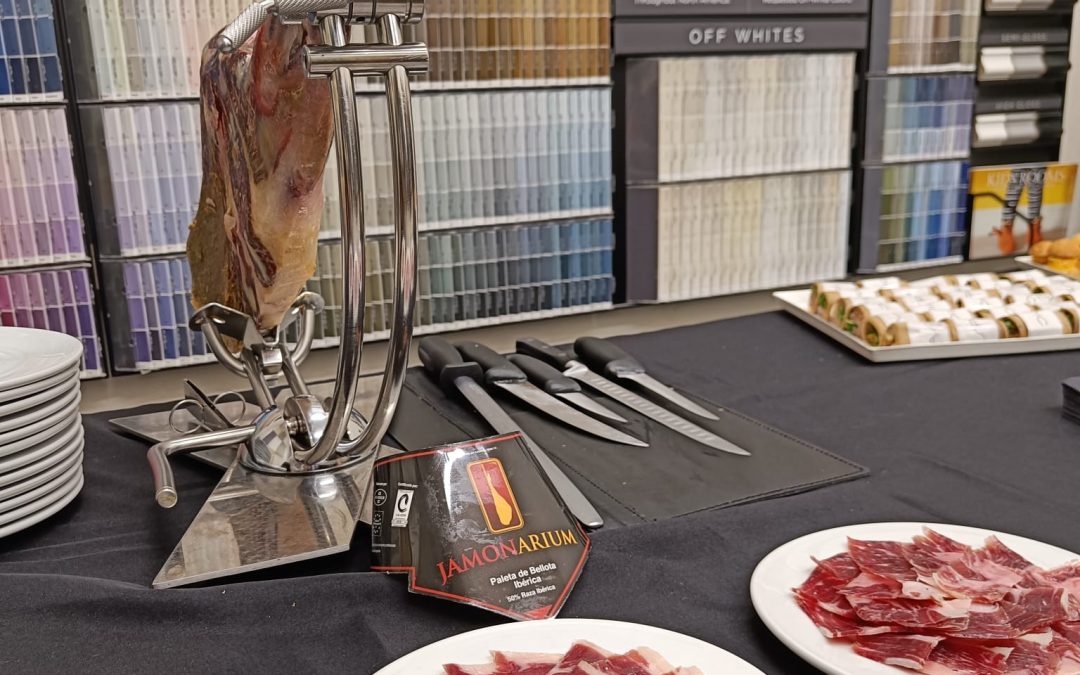
Exhibiting at a trade show or conference in late August or early September poses unique challenges that go beyond capturing leads or designing information panels.. Although most modern exhibition halls have powerful air conditioning systems, assembly days, the openings of large gates for machinery, The waves of thousands of visitors and the late summer heat waves of the plateau or central Europe cause extreme thermal fluctuations inside the stands. For a brand that decides to install a premium tasting space, heat is enemy number one. Entrusting Iberian ham to stand staff or a conventional catering service during these dates is a critical risk.. Only the figure of a professional ham cutter for fairs guarantees that the product remains impeccable, safe and delicious under any weather circumstance.
The science of sweating: The delicate melting point of Iberian fat
To understand the importance of a professional at summer fairs, you have to analyze the physics of the product. Authentic acorn-fed ham stands out for its high oleic acid content, from free-range pig feeding. This noble fat has a very low melting point, standing between the 22°C and 24°C.
When the flag remains in that range, the ham “suda” in a perfect way, acquiring that melting and translucent texture that international consumers fall in love with.
However, If the stand exceeds 28°C o 30°C due to focused lighting or room air conditioning failures, the fat begins to melt uncontrollably, oxidizing at a forced pace and ruining the flavor and texture of the lean, that becomes pasty and rancid. The master cutter is a food technician who knows how to read these variations. Modify the cutting rhythm, protects the exposed areas of the piece with its own covering fat and manages the exposure times on the plate so that the customer always receives a slice at its optimal consumption temperature.
The protocol of the “last mile” and maintenance at the stand
The work of the independent professional cutter at the late summer fairs begins long before the first porcelain tray is opened. Implies a strict logistical conservation protocol:
- Adapted cold chain: The transfer of the pieces from the warehouse to the exhibition center warehouse must be carried out in vehicles with stable controlled temperatures., preventing the ham from suffering thermal shock in trunks or vans exposed to the August sun.
- Protected acclimatization: Once at the stand, Ham cannot be cut straight out of a cold room (where the fat is blocked and does not transmit flavor), but it cannot be left on the counter under halide lights either.. The professional manages a progressive acclimatization in the coolest areas of the stand.
- Radical food safety and hygiene: Heat multiplies bacteriological risks. A certified cutter applies a military tool cleaning protocol, disinfection of supports and removal of rusty outer bark, ensuring that each cut complies with the most demanding European health regulations.
A refreshing and sophisticated oasis for the weary visitor
Walking for hours through the halls of a trade fair at the end of August exhausts any potential buyer or investor.. Offering heavy catering or hot drinks scares away visitors. The station of a professional ham slicer is transformed, on these dates, in an oasis of hospitality.
Thin slices of acorn-fed Iberian ham, cut with millimeter precision so that they dissolve in the mouth effortlessly, paired with a very cold sparkling white wine, a Brut Nature cava or a craft beer at cellar temperature, offer a light experience, sophisticated and extremely comforting. This gourmet contrast in the summer heat generates an immediate psychological impact on the visitor., that associates your brand with concepts of freshness, operational excellence, relief and maximum corporate status.
 Español
 English
 中文(简体)
 Nederlands
 Français
 Deutsch
 Italiano
 日本語
 Português
 Русский